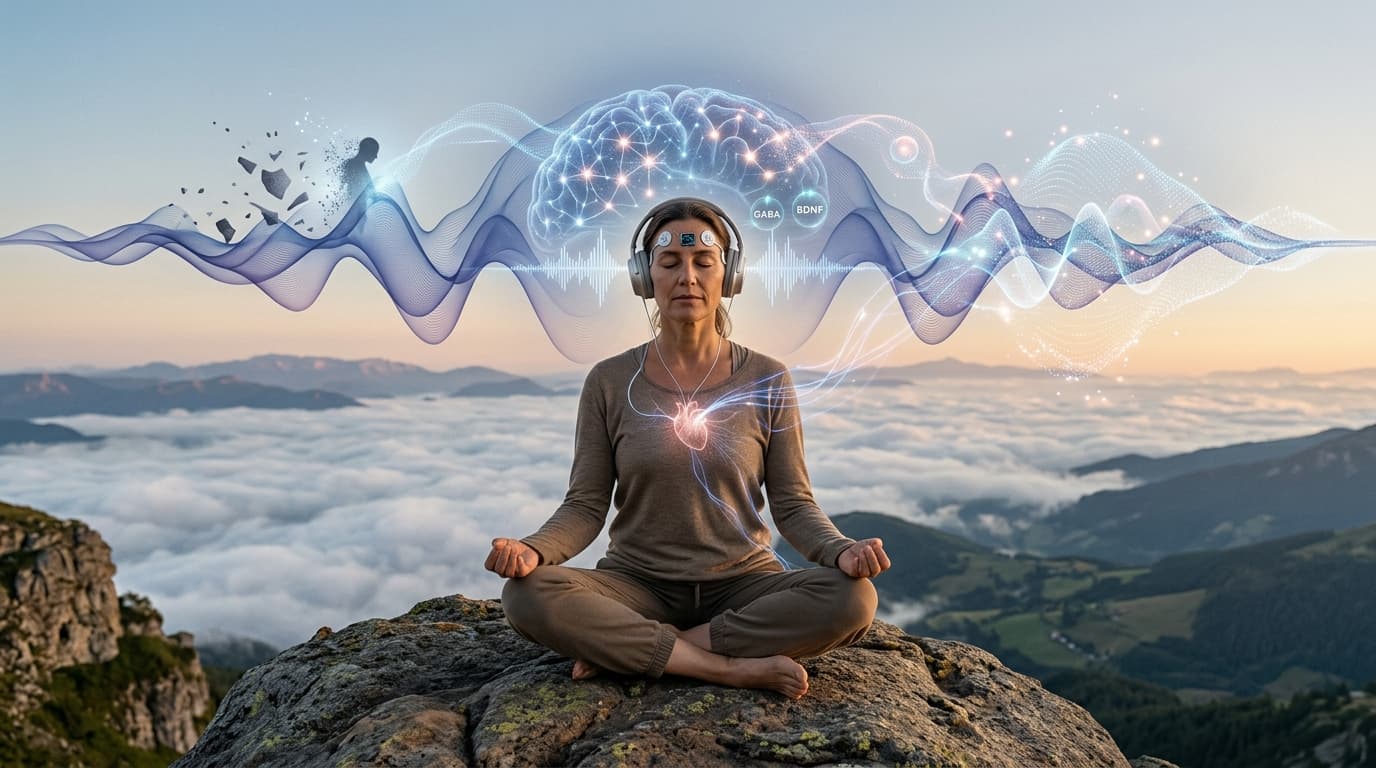
What Are Theta Waves, and What Does Science Prove?
The human brain operates on electrical activity measured in Hertz (Hz). In daily life—while working, conversing, or problem-solving—our brains primarily run on beta waves (14–30 Hz), characterized by active focus and analytical thinking. Theta waves (4–8 Hz), on the other hand, reflect a far slower, deeper state of consciousness. This is the state we naturally enter during REM sleep, under hypnosis, or in deep meditation.
In recent years, studies using EEG and fMRI neuroimaging have shown that intentionally entering a theta state triggers measurable changes in the brain:
Enhanced Neuroplasticity: Research shows that theta frequencies originate naturally in the hippocampus—the brain region responsible for learning, memory, and emotional processing. This state promotes the formation of new synaptic connections, allowing the brain to rewire itself far more efficiently.
Emotional Regulation and Anxiety Reduction: Neurological studies have found that increased theta wave power in the brain's frontal regions correlates with a sharp decline in anxiety and stress, alongside an improved ability to process and release traumatic memories without triggering an automatic stress response.
Access to the Subconscious: In a beta state, the brain's executive network filters incoming information to protect existing worldviews. In theta, these mental inhibitions soften, opening direct access to core beliefs and deep-rooted behavioral patterns stored in the subconscious.
The Physiology of Change: What Happens in the Body During Theta Meditation?
The impact of theta meditation isn't purely mental; it triggers a physiological chain reaction throughout the body:
Shift to the Parasympathetic Nervous System
When brainwaves slow down to 4–8 Hz, the brain sends a deep calming signal down the vagus nerve. The sympathetic nervous system (the "fight-or-flight" response) stands down, allowing the parasympathetic nervous system ("rest and digest") to take over completely. Heart rate drops, blood pressure stabilizes, and hormone secretion shifts dramatically.
Amygdala Suppression and Reduced Stress Hormones
The amygdala—the brain's fear and alarm center—dampens its activity during theta meditation. Consequently, the thyroid and adrenal glands stop flooding the bloodstream with stress hormones like cortisol and adrenaline. Lowering cortisol levels frees up the immune system to focus on cellular repair, chronic inflammation reduction, and tissue regeneration.
Shifts in Brain Chemistry
While in a theta state, the brain increases the release of essential neurotransmitters and compounds:
GABA: An amino acid that dampens neural overactivity and induces deep calm.
Endorphins: Natural pain relievers that elevate mood.
BDNF (Brain-Derived Neurotrophic Factor): A protein that stimulates the growth of new neurons and sharpens cognitive function.
Healing and Habit Change: Why Conscious Effort Often Fails
Most people trying to break a bad habit—whether it's emotional eating, procrastination, sudden outbursts, or destructive relationship patterns—approach it from a beta brainwave state. They rely on willpower, logic, and self-persuasion. However, willpower is driven by the conscious mind, which accounts for roughly 5% of total cognitive activity. The remaining 95% is run by automatic programs hardwired into the subconscious.
During theta meditation, the boundary between the conscious and subconscious becomes permeable. This state mirrors self-hypnosis, putting the brain in a state of high suggestibility. When you plant a new intention, a positive self-belief, or a visualization of a desired behavior while in theta, the idea bypasses the analytical filter of the conscious mind. It prints directly into your subconscious neural pathways, paving the way for lasting, deep-rooted transformation.
The Intersection of Theta Meditation and Quantum Physics
The connection between deep states of consciousness and quantum physics has become a hot topic in recent years. To understand this crossover accurately, it helps to separate the strict physics from the conceptual framework:
The Observer Effect and the Wave Function: In quantum physics, elementary particles exist as a "wave of possibilities" (a wave function) until measured or observed, at which point the wave collapses into a defined physical outcome. Conceptually speaking, when we operate in everyday beta, our focus remains locked onto current physical reality and past memories, effectively "collapsing" the same old reactions and perceptions over and over. In theta meditation, as external senses quiet down and awareness detaches from the physical body and time, consciousness shifts from focusing on matter to experiencing energy and potential.
Electromagnetic Fields and Coherence: The brain and heart generate measurable electromagnetic fields. Coherence research (such as work done by the HeartMath Institute) demonstrates that when brainwaves slow to theta and the heart enters a state of high coherence (Heart-Brain Coherence), the body's overall electromagnetic field becomes significantly more organized and powerful.
Quantum Theories of Consciousness (Microtubules): Frontier scientific hypotheses—such as the Orchestrated Objective Reduction (Orch-OR) model developed by physicist Sir Roger Penrose and anesthesiologist Stuart Hameroff—suggest that the brain's deepest information processing occurs inside cellular structures called microtubules via quantum mechanics. Under this view, quieted states of consciousness like theta create the noise-free environment needed for these quantum cellular processes to take place.
3 Effective Ways to Practice Theta Meditation
You don't need years of monastic training to reach theta intentionally. Here are three accessible, highly effective techniques:
Capitalize on the "Hypnagogic Window" (Waking and Falling Asleep)
The most natural gateway to theta occurs during the automatic transitions between waking and sleep.
How to do it: Right after waking up in the morning (before touching your phone) or right as you drift off at night, your brain naturally lingers in theta. Close your eyes, take a few deep breaths, and focus on a positive affirmation or a vivid visualization of the change you want to make. Because the subconscious mind is wide open during these moments, new programming takes hold rapidly.
Use Binaural Beats
This auditory technology leverages the brain's sound processing to entrain brainwaves to a desired frequency.
How to do it: Put on a pair of stereo headphones (headphones are essential). Play an audio track tuned for theta—for instance, 200 Hz in one ear and 206 Hz in the other. Your brain perceives the 6 Hz difference and synchronizes its own brainwave frequency to match it. Sit or lie down comfortably, close your eyes, and let your brain ride that rhythm for 15 to 20 minutes.
Rhythmic Breathing and a Deep Body Scan
Slowing your breathing pattern is the most direct remote control for dialing down brainwave frequency.
How to do it: Practice box breathing or diaphragmatic breathing (inhale for 4 seconds, hold for 4 seconds, exhale slowly for 6–8 seconds). Next, slowly sweep your attention from your toes up to the crown of your head, imagining each muscle going to sleep and releasing tension. As physical sensations settle and your focus turns inward, your brainwaves naturally drop from beta down into alpha, and finally into deep theta.