What Are Statins and How Do They Work?
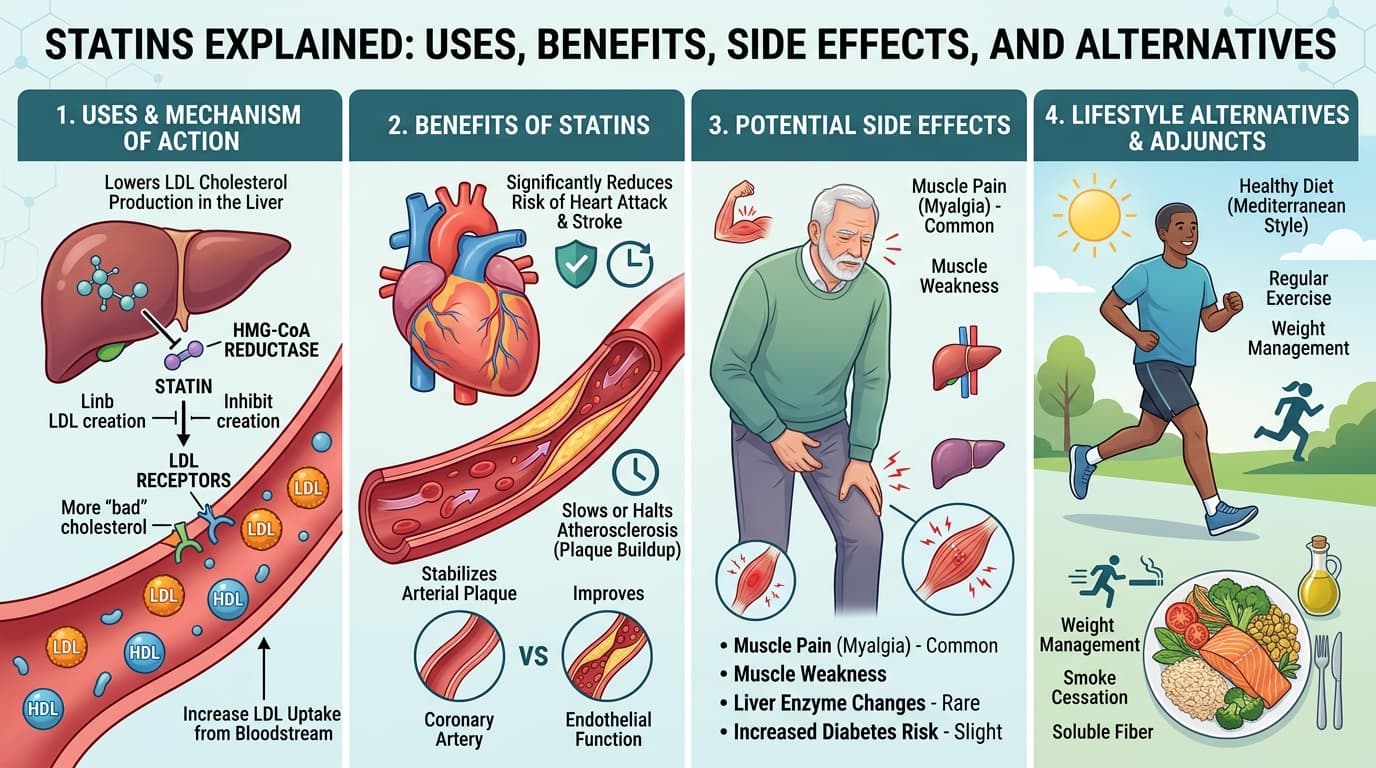
Statins are a class of medications that block a liver enzyme called HMG-CoA reductase. This enzyme serves as a critical bottleneck in the body's internal cholesterol production.
When liver cholesterol production slows down, the liver responds by creating more LDL receptors on its surface. These receptors actively pull circulating LDL cholesterol out of the bloodstream, clearing it from general circulation.
Beyond lowering LDL numbers, statins offer additional cardiovascular protective properties known as pleiotropic effects:
Reducing inflammation: Calming inflammatory markers within the blood vessel walls.
Stabilizing arterial plaque: Reinforcing plaque caps to prevent rupture, which is the primary cause of acute heart attacks.
Improving endothelial function: Supporting the flexibility and health of the inner lining of blood vessels.
Common statins in clinical use include atorvastatin (Lipitor), rosuvastatin (Crestor), simvastatin (Zocor), and pravastatin (Pravachol).
Key Benefits of Statin Therapy
The principal advantage of statins extends far beyond improved lab results—it translates directly into measurable health outcomes:
Lower mortality and cardiovascular events: Clinical data shows that for every reduction of 38 mg/dL (1 mmol/L) in LDL cholesterol, the risk of a major cardiovascular event drops by roughly 20% to 25%.
Proven secondary prevention: For individuals who have already suffered a heart attack, stroke, or undergone stent placement, statins substantially reduce the likelihood of a recurrent event.
Primary prevention for high-risk individuals: Statins protect people with multiple risk factors (such as diabetes, high blood pressure, or a strong family history) before a first cardiac event ever occurs.
Drawbacks, Side Effects, and Risks
Despite their benefits, statins—like any prescription drug—carry potential side effects that warrant careful consideration:
Muscle symptoms (Myalgia): The most frequently reported complaint is muscle pain, weakness, or cramping. While 10% to 15% of patients report muscle symptoms in observational settings, double-blind placebo studies reveal that a significant portion of these reports stems from the "nocebo effect" (the psychological expectation of side effects). Severe muscle damage (rhabdomyolysis) is extremely rare, occurring in fewer than 0.1% of patients.
Elevated liver enzymes: Mild, temporary rises in liver enzymes occur occasionally, but severe liver injury is exceptionally rare. Routine, frequent liver blood tests are no longer recommended unless specific symptoms arise.
Increased diabetes risk: High-dose statin therapy carries a slight increase in the risk of developing type 2 diabetes, primarily among individuals who already have prediabetes. However, the cardiovascular protection provided by statins generally far outweighs this small incremental risk.
Cognitive complaints: A small number of patients report temporary memory lapses or brain fog. Extensive clinical trials have failed to establish a direct causal link, and symptoms usually resolve if the medication is discontinued.
Who Needs to Take Statins?
Deciding to start a statin isn't based on a cholesterol number in isolation. Physicians evaluate an individual's total 10-year risk profile for developing cardiovascular disease.
Primary candidates for statin therapy generally include:
Patients with established cardiovascular disease: Individuals with a history of heart attack, stroke, angina, or peripheral artery disease (secondary prevention—where statins are a standard baseline treatment).
Individuals with severely high LDL cholesterol: Anyone with LDL levels at or above 190 mg/dL, which frequently points to familial hypercholesterolemia (a genetic condition).
Adults with diabetes: People aged 40 to 75 with diabetes, even if their baseline cholesterol levels appear normal, due to their elevated overall vascular risk.
High-risk individuals: People whose calculated 10-year cardiovascular risk score is elevated based on age, blood pressure, smoking status, cholesterol levels, and family history.
Can a Natural Diet Replace Statins?
A common question among patients is whether lifestyle changes can eliminate the need for prescription medication altogether.
The Role of Diet and Lifestyle
Adopting a heart-healthy diet—such as a Mediterranean pattern rich in soluble fiber (oats, beans), vegetables, fatty fish, and unsaturated fats (olive oil, nuts) while limiting saturated and trans fats—combined with regular physical activity and weight management, provides substantial health benefits.
However, dietary modifications alone typically lower LDL cholesterol by about 10% to 15%.
Why Diet Isn't Always Enough
Roughly 70% to 80% of circulating body cholesterol is produced internally by the liver; only a minor portion comes directly from dietary sources. For individuals with a genetic predisposition or significant preexisting arterial buildup, a 10% reduction in LDL rarely brings levels down to target guidelines (which can be below 55 mg/dL for high-risk individuals).
The Integrated Approach
Diet and lifestyle improvements are not a replacement for statins when a clear medical need exists. Instead, they serve as the foundational baseline that works alongside drug therapy. For low- to moderate-risk individuals with mild cholesterol elevation, a 3- to 6-month trial of dedicated lifestyle changes is typically the recommended first step.
Should Older Adults Take Statins?

Statin therapy in older populations (aged 75 and above) requires a tailored, individualized clinical approach.
For secondary prevention (after a heart event): The clinical evidence is clear. Even in advanced age, statins continue to significantly lower the risk of secondary heart attacks and mortality, making them standard recommended care.
For primary prevention (no prior heart event): The benefits for adults over 75 without existing heart disease are less conclusive in older trials, though recent real-world evidence suggests continued cardiovascular protection.
Key factors evaluated in older adults include:
Overall life expectancy and quality-of-life goals.
Frailty and muscle side effects: Older individuals may be more vulnerable to muscle weakness, which can impact daily mobility and increase fall risks.
Drug interactions: Taking multiple medications (polypharmacy) increases the potential for adverse drug interactions.
In clinical practice, doctors often initiate treatment in older adults at lower doses and adjust gradually while monitoring closely for side effects.